
Custom Epoxy River Table
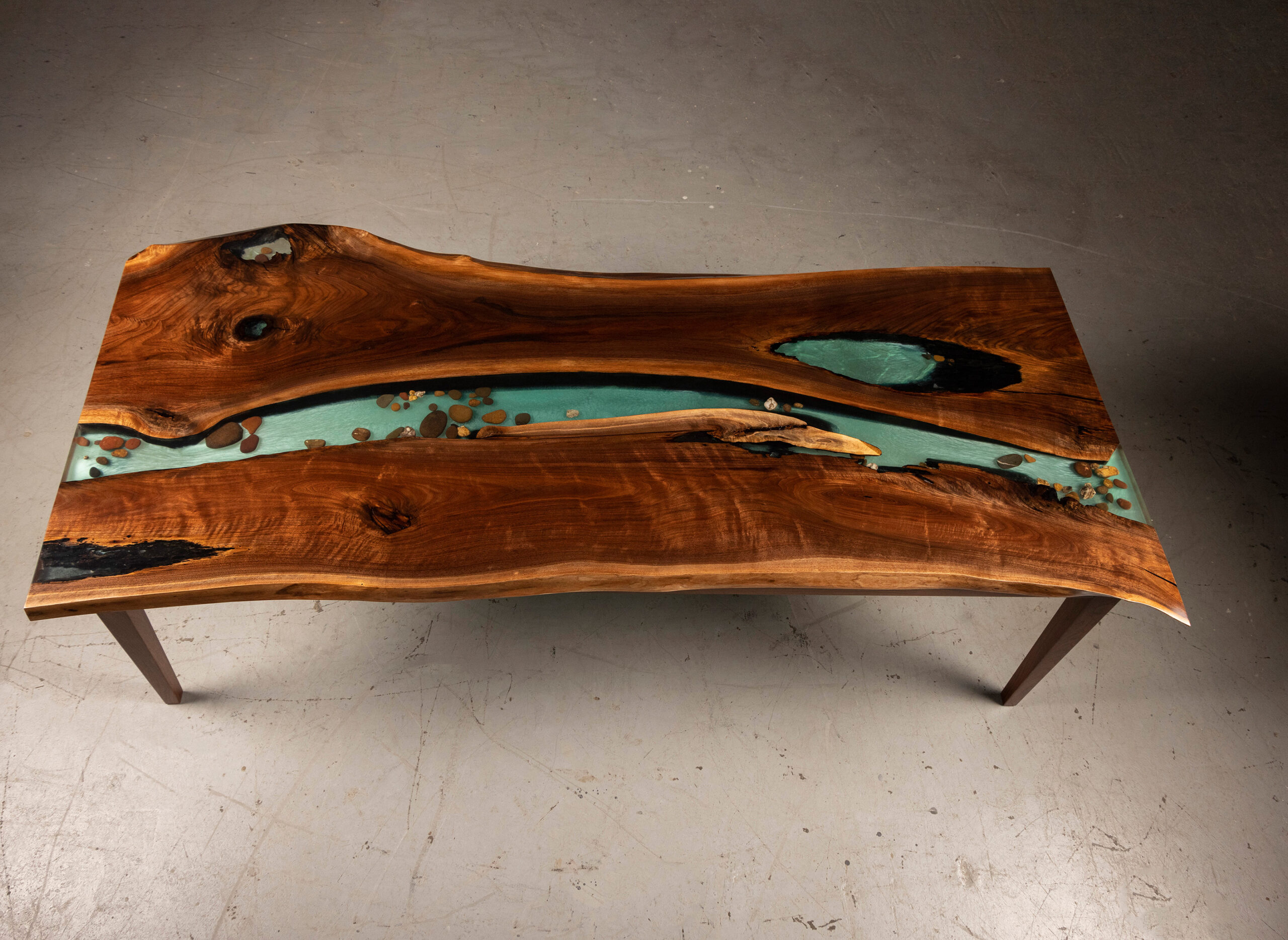
Two hardwood slabs, a poured resin channel between them, cured flat and polished Request A QuoteA river table is two slabs of hardwood held apart by a channel of cured resin. The wood keeps its natural edge on the inside faces, so the resin channel takes the exact shape the tree grew. That is the whole idea, and everything else is execution: which species, how thick, what color the pour reads at, and what carries the top. We have built the form as dining tables, conference tables, coffee tables, and side tables, each one drawn around the slab it started from.


The process behind our custom epoxy table
Hardwood comes to us from about 150 miles away in Pennsylvania, which keeps transport short and lets us select boards in person. Slabs are dried and then acclimated in the shop, because a slab that moves after the pour will crack the resin. Only once moisture content is stable do we mill the inside edges and set the two halves in the mold.
Resin is mixed, tinted, and poured under controlled conditions. Viscous material traps air, so the pour is monitored and the cure runs slow. The top is then flattened, sanded through progressive grits, polished, and coated before it is paired with a base.
Most of these tables end up as dining tables, and the form earns that. A river table gives a long room a single visual line straight down the middle. The channel also reads differently under daylight than it does under a pendant. Because people put their hands on this table constantly, we finish the underside to the same standard as the top. For the same presence without resin, look at our live edge dining table.
The epoxy river table.
Designed with your vision.
Modeled accordingly.
Resin color is the fastest way to change the character of the piece. Black reads as a void between the slabs, and blue and green read as water. Clear reads as glass, with the floor visible straight through the top.
Bases carry as much of the design as the top does. We build steel and brass legs, solid wood frames, full slab pedestals, and matching resin bases. A waterfall table takes that further and runs the top and the resin over the edge in one piece. Independent designers regularly send us their own drawings and species preferences, and we build to those.
The Colorado River design reaches the same result without resin. Tempered glass is inset between the two slabs, so the channel becomes an actual opening rather than a filled one. It sits on a blackened metal base, with clean or live edges on the top. Species run to American black walnut, spalted maple, and ambrosia maple. For the river line without the depth and weight of a poured top, this is the version to look at.
Epoxy river table product specifications
- Designed and built to order in our Brooklyn studio at 276 Greenpoint Avenue
- Species: American black walnut, spalted maple, ambrosia maple, oak, and others on request
- Hardwood sourced roughly 150 miles away in Pennsylvania
- Edges: live edge or clean edge, with thickness specified per project
- Resin: pigmented or clear, poured and cured under controlled conditions
- Bases: steel, brass, solid wood frame, slab pedestal, or matching resin
- Dining height 28″ to 30″; length, width, shape and thickness are all custom
- Ships across the United States and internationally
Grain and finish
Grain can be accentuated through kiln drying, stabilization, or heat treatment, then pushed further with stain or finish.
Hardwood species & Options
for the Epoxy river table

American Black Walnut

Oak

Distressed Maple

Spalted Maple

Ebonized Oak

Teak

Bleached Oak

Maple
The reverse river table
The reverse version of the table inverts that geometry. Straight-cut boards form the outer edges, a live edge slab sits in the middle, and resin fills both sides of it. The natural outline ends up as an island down the center of the table instead of a channel through it.
Objects set into the pour
The resin cures around whatever is sitting in the mold. Clients sometimes send us something to embed: stones from a specific beach, driftwood, a small heirloom. The object has to be dry, stable, and thin enough to sit below the finished surface. Done well, it turns a luxury dining table into a record of something.
Related reading: live edge dining tables, live edge furniture, our resin river table guide, and wood species and finishes.
Pricing and Inquiries
Price follows the slab, the size, and the base, so every river table is quoted on its own. Call 1 (347) 309-6217 or come see slabs in person at 276 Greenpoint Avenue, Brooklyn.
Frequently Asked Questions
What is the difference between epoxy and resin tables?
The epoxy vs. resin inquiry is one of classification and detail instead of style. While the terms are used interchangeably, at least in reference to tables, there is a slight distinction to be made, which doesn’t confuse the stylistic outcome. A good way to differentiate between the two is to view resin as a general term which refers to a wide range of synthetic or natural substances with a viscous, liquid texture hardened into a solid material.
In contrast, epoxy tables rely on a specific high-performance type of resin that is known for its chemical resistance, and favorable mechanical properties, including elongation, hardness and tensile strength. Put simply, epoxy resin is a specific resin classification that happens to be fully representative of this furniture category.
Can I order a round epoxy table?
While round epoxy tables represent a rare design decision, we can certainly take a look at the idea and bring it to life. Depending on joinery and grain pattern preferences, we might consider specific dimensions and offer different solutions on how to approach the project. Our designers and craftsmen have worked on round and oval table models with great success, so the round epoxy table is definitely a project worth engaging.
What distinguishes a high-end epoxy table?
The range in this category is wide, and price alone does not tell you where a table sits in it. A high-end epoxy table is distinguished by four things: the hardwood, the resin system, the pour conditions, and the finishing.
Which color and grain combinations are available?
The aesthetic uniqueness of the epoxy river table is largely determined by its texture and color. Depending on the choice of wood, its early-stage treatment and subsequent finishing techniques, we can achieve a striking visual distinction between any two models. Grain patterns can be accentuated through kiln-drying, stabilization or heat treatment, and additionally highlighted with staining or a protective finish. Clients can choose between a variety of wood species that react differently to these treatments, providing for a unique stylistic narrative.
As for the epoxy, we can materialize any color along the spectrum, including opaque black and white, with or without metallic effects or gradients. Combined with the dark and rich tones of walnut, cherry and redwood, or the broad stylistic variety of maple and oak, there is hardly an aesthetic concept that we cannot bring to life.
Visit with Appointment Only
STUDIO & WORKSHOP
276 Greenpoint Avenue
Building 9 Floor 5
Brooklyn, NY 11222
1 (347) 309-6217
Related Designs

Communal Tables

Colorado Dining Tables

Flow Pedestal Table
Home | Collection | Custom | Portfolio | Materials & Finishes | Art | Blog | FAQ | Contact








Studio & Gallery: 276 Greenpoint Avenue, Brooklyn, NY 11222, Phone: 1 (347) 309.6721
Terms of Use | Privacy Policy | Copyright© SENTIENT™ Furniture Inc. All rights reserved.